 Mike Brattain
How To Choose The Right Software Development Partner
 Josh Mitchell : Jul 1, 2020, 12:31:15 PM
Choose the right software development partner for your projects. Ask these ten questions to ensure your software project will be in good hands.

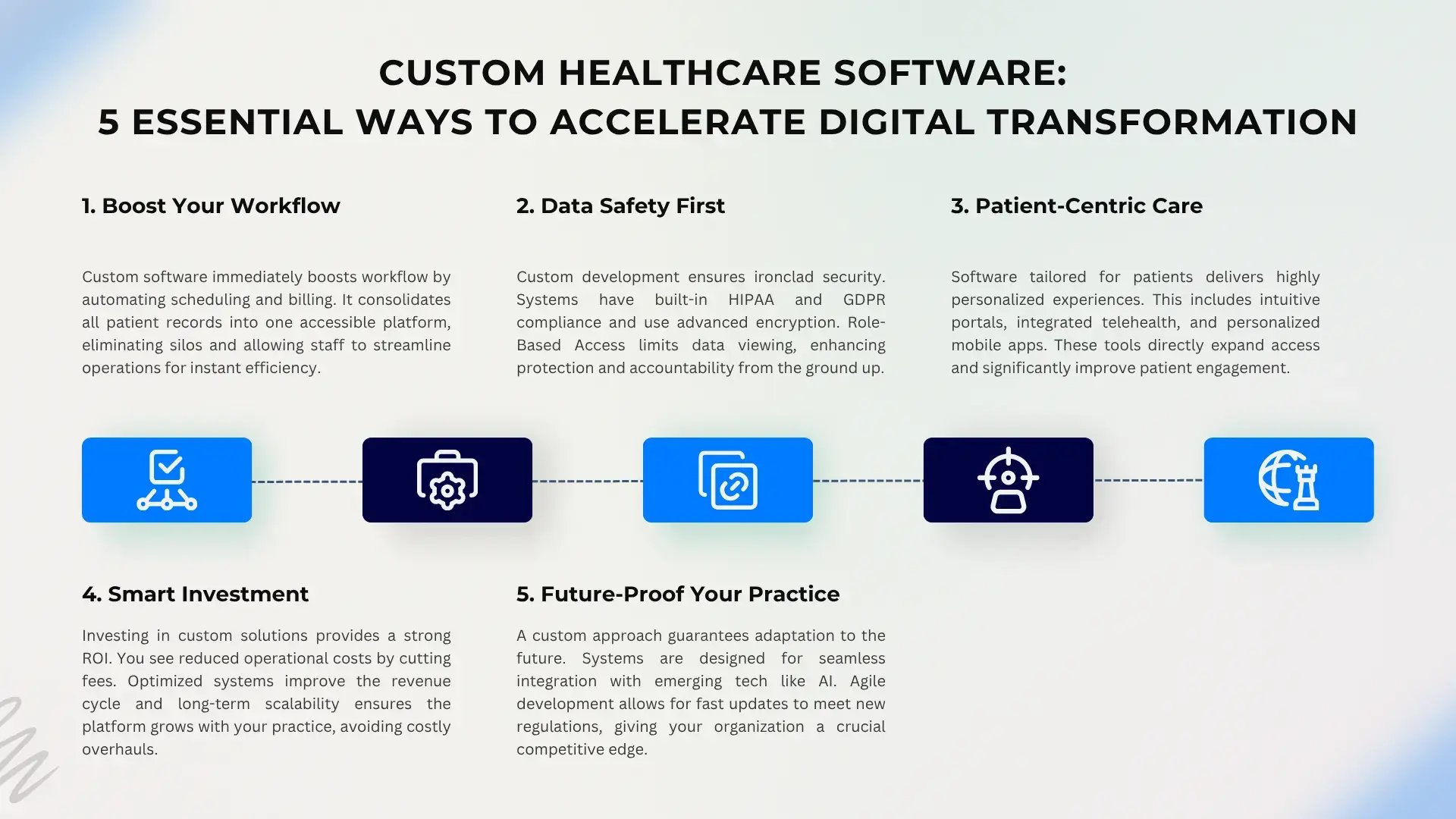
Digital transformation in healthcare is no longer optional. Hospitals, clinics, and health tech companies face mounting pressure to deliver better care while navigating regulatory complexities, staffing shortages, and rising costs. Traditional systems can’t keep pace with the increasing demand for secure data exchange, patient engagement, and operational efficiency.
This is where custom healthcare software development becomes essential.
By leveraging specialized healthcare software development services and agile development methodologies, organizations can design systems tailored to their workflows, compliance requirements, and patient engagement goals. These six proven strategies show how healthcare-focused software development drives digital transformation and supports better outcomes, stronger security, and continuous innovation.
Every healthcare organization has unique clinical, administrative, and operational needs that off-the-shelf solutions often fail to meet. Custom healthcare software development aligns technology with real-world workflows, enabling seamless integration between EHRs, billing systems, telemedicine tools, and patient portals.
Example:
A hospital network built a custom telemedicine platform with integrated billing and EHR synchronization. The result: a 25% reduction in patient check-in times and improved clinical accuracy.
Healthcare IT News reports that 89% of healthcare leaders believe custom software gives them a competitive advantage.
Agile development emphasizes iteration, collaboration, and adaptability—critical advantages in a fast-moving healthcare landscape.
By incorporating real-time feedback from clinicians and administrators, healthcare teams can release updates faster and ensure technology closely aligns with user needs.
Example:
A behavioral health startup used agile sprints that included input from nurses and physicians. Usability improved by 30% within the first release cycle.
“Agile development allows healthcare systems to evolve at the speed of clinical innovation,” says Lisa Carmichael, Senior IT Director at MedTech Global.
Could your healthcare organization benefit from patient-centered technology designed around your actual workflows?
Compliance and security are core pillars of healthcare IT. Following structured software development process steps—from planning to testing—ensures every feature meets stringent safety, privacy, and regulatory standards.
Example:
A community clinic incorporated automated vulnerability scans throughout development and reduced security incidents by 40%.
Industry Statistic:
According to HealthITSecurity, 64% of healthcare breaches stem from outdated or unpatched systems.
Patient engagement has become a defining factor in care quality and organizational performance. Healthcare-specific CRM solutions enable providers to personalize communication, coordinate follow-up care, and track interactions across the continuum of care.
Example:
A Detroit-based hospital built a custom CRM system that automated reminders and reduced missed appointments by 28%.
HIPAA Journal notes that CRM-enabled organizations experience a 20% boost in patient retention.
As digital demands grow, outsourcing has become an efficient way for healthcare organizations to innovate without overextending internal resources.
Benefits include:
Reduced development costs
Faster time-to-market
Access to specialized technology talent
Enhanced focus on patient care
Example:
A healthcare analytics company outsourced development of its predictive AI engine, reducing project duration by 40% and cutting costs by nearly one-third.
“Outsourcing development allows healthcare teams to focus on patient outcomes while experts handle the technical innovation,” says Brian Tran, Health IT Consultant.
AI-driven and analytics-backed software allows providers to generate insights, streamline operations, and support predictive care models.
Example:
A healthcare network deployed a custom data analytics dashboard that identified patient engagement trends and reduced missed appointments by 18%.
Industry Insight:
Forrester Research found that 78% of healthcare executives view analytics-driven software as key to improving clinical and financial performance.
1. What are healthcare software development services?
These are tailored IT solutions designed to improve patient care, operational efficiency, and regulatory compliance in healthcare organizations.
2. Why is custom healthcare software development important?
It enables organizations to create systems that match their workflows, integrate seamlessly with existing tools, and meet compliance requirements.
3. How does agile development benefit healthcare?
Agile promotes continuous feedback, faster releases, improved usability, and better alignment with clinical needs.
4. What are the main benefits of outsourcing software development?
Cost savings, scalability, faster innovation, and access to specialized expertise.
5. What steps are included in the software development process?
Requirement analysis, design, coding, testing, deployment, and ongoing maintenance.
Custom healthcare software development is reshaping how providers deliver care, manage data, and improve operational performance. Through agile methodologies, data-driven systems, and strategic outsourcing, healthcare organizations can innovate faster while staying compliant and secure.
SYSTEM X partners with healthcare leaders to create tailored, scalable, and secure software solutions that accelerate digital transformation and support better patient outcomes.
Ready to modernize your healthcare systems with intelligent, custom software built for your organization’s unique needs?
 Josh Mitchell : Jul 1, 2020, 12:31:15 PM
Choose the right software development partner for your projects. Ask these ten questions to ensure your software project will be in good hands.

 Mike Brattain : Jun 25, 2025, 12:00:00 AM
Stay secure heading into Q3 2025 with this essential mid-year cybersecurity checkup. Review key risks, update defenses, and ensure your business is...

 Rubens Perdomo : Feb 9, 2021, 10:30:00 AM
What are the pros and cons of software outsourcing? Discover what you need to know!