Cloud vulnerability continues to challenge organizations that rely on cloud services for scalability and agility. As workloads expand across multiple platforms, new layers of complexity and risk emerge. The misconception that cloud providers handle every aspect of security leaves many businesses exposed to breaches that could have been avoided with proper management.
A growing number of data breaches stem from unclear responsibility, poor configuration, and delayed patching. Providers secure their infrastructure, but clients are responsible for protecting data, applications, and access points. Misunderstanding this boundary creates critical exposure.
According to IBM Security (2024), 45 percent of cloud breaches are caused by misconfigurations. These incidents often go unnoticed until after data loss or service disruption occurs. To prevent these costly events, organizations must strengthen visibility, automation, and control across every layer of their infrastructure.
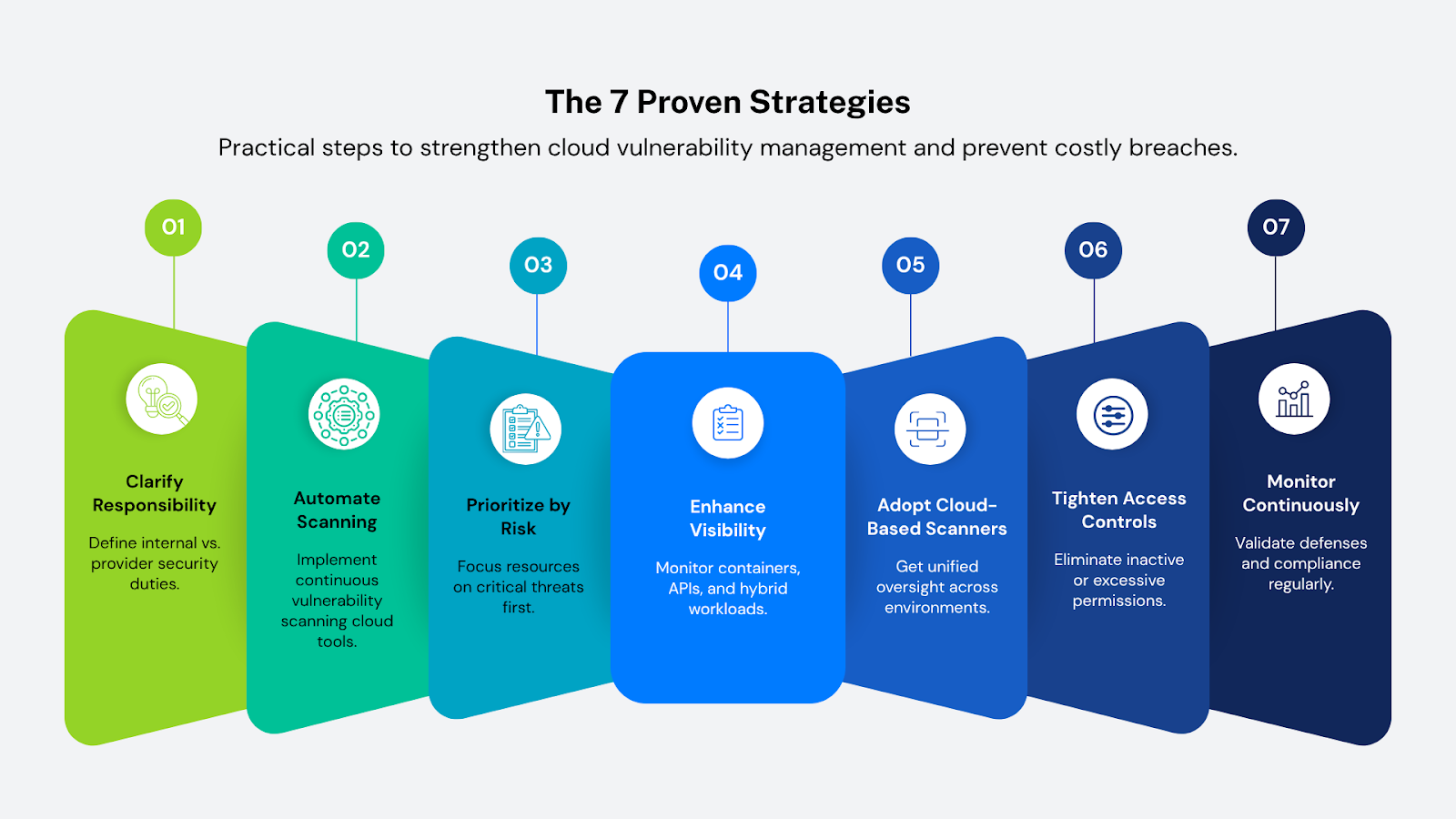
This article presents seven proven strategies that help leaders mitigate cloud vulnerability, enhance compliance, and secure their business operations against evolving digital threats.
Strengthen Management Through Shared Responsibility
One of the most critical steps in addressing cloud vulnerability management is understanding where your provider’s duties end and yours begin. Many companies mistakenly believe that security is fully handled by their cloud provider, but the truth is far more complex. Providers secure their infrastructure, while clients remain responsible for application configurations, access control, and data protection.
Example: A financial firm experienced unauthorized data exposure when it assumed its provider included vulnerability scanning for hosted databases. The incident revealed that the client, not the provider, was responsible for application-layer scans.
How well does your team understand its side of the shared responsibility model? For a clear overview of shared responsibility models, see the Microsoft Security Blog
Automate Vulnerability Scanning
Manual vulnerability detection can’t keep pace with today’s cloud speed. Automating vulnerability scanning cloud processes ensures consistent coverage and rapid response to new threats. Automation allows organizations to schedule scans, remediate issues instantly, and maintain compliance without burdening staff.
68% of enterprises that implemented automated scanning reduced their mean time to remediation by 40% (Cloud Security Alliance, 2024).
Example: A retail chain reduced exposure time from weeks to hours by integrating automated cloud vulnerability scanning into its CI/CD pipeline.
For more insights, the Cloud Security Alliance Blog explores how automation transforms vulnerability management.
Prioritize Risk Over Volume In Managing Cloud Computing Vulnerabilities
Not all vulnerabilities carry equal weight. A successful cloud vulnerability management plan ranks issues by potential business impact rather than quantity. Prioritization helps focus limited resources on the threats most likely to be exploited.
“Risk-based prioritization transforms patching from guesswork into strategic defense,” says Lila Tran, Cloud Security Advisor.
57% of organizations using risk-based vulnerability management saw a 30% reduction in breach likelihood (Forrester, 2024).
Learn how global companies are rethinking vulnerability management from Forrester Research
Expand Visibility Of Cloud Security Vulnerabilities
Modern infrastructures include containers, APIs, serverless functions, and hybrid environments, each introducing unique risks. Relying solely on infrastructure scans leaves many cloud security vulnerabilities undetected. Expanding visibility ensures consistent protection across every layer.
Example: A healthcare provider left patient data unprotected due to unscanned APIs connecting its EHR system to third-party apps.
“Visibility is security’s foundation. You can’t protect what you can’t see,” says Dr. Jana Ortiz, Identity Security Expert.
Explore how businesses address these visibility gaps at Palo Alto Networks Unit 42.
Deploy A Cloud Based Vulnerability Scanner For Unified Oversight
Traditional scanners often fail to capture the dynamic nature of cloud workloads. A cloud based vulnerability scanner adapts to scaling environments and integrates with CI/CD pipelines to deliver real-time insights. This tool identifies hidden exposures before they can be weaponized.
Statistic: 52% of enterprises discovered previously unseen vulnerabilities after adopting cloud-native scanners (CyberTech Insights, 2024).
How might switching to a cloud based vulnerability scanner improve accuracy across your hybrid systems?
Read more about best practices from Tenable Research.
Strengthen Identity & Access Management To Mitigate Cloud Vulnerabilities
Many breaches occur not from software flaws but from poor identity controls. Overly broad permissions, stale credentials, and unmanaged roles make it easy for attackers to exploit access points. Reducing privilege levels and automating IAM reviews can mitigate the most common cloud vulnerabilities.
Example: A logistics company experienced credential misuse after leaving admin privileges active for former contractors. Implementing quarterly access audits cut identity-related alerts by 60%.
Identity mismanagement contributed to 45% of cloud breaches in 2024 (Verizon DBIR, 2024).
For more detailed insight, visit the Verizon Data Breach Investigations Report.
Monitor, Validate, & Adapt Continuously
Cloud vulnerability management doesn’t end with remediation. Continuous monitoring ensures patches hold, new threats are detected, and compliance standards remain intact. Regular validation reports build executive confidence and regulatory trust.
Expert Insight: “The best cloud defense isn’t static, it evolves as fast as the environment itself,” notes Dr. Ian Mercer, Cyber Defense Analyst.
Organizations using continuous validation reduced recurring vulnerabilities by 35% in one year (Verizon DBIR, 2024).
Review frameworks from the NIST Special Publication 800-137 for structured guidance on continuous validation.
FAQ: Common Questions About Cloud Vulnerability
- What is cloud vulnerability and why does it matter?
It refers to weaknesses in configurations, applications, or permissions that attackers can exploit within cloud environments. Managing cloud vulnerability is essential to maintaining data integrity and operational continuity.
- Does the cloud provider provide vulnerability scan tools automatically?
Some providers include limited scanning, but customers must manage deeper application-level checks independently. Always verify scope before assuming full coverage.
- What are the biggest cloud computing vulnerabilities in 2025?
Misconfigurations, API exposures, and identity-based attacks remain the most common and damaging vulnerabilities.
- How often should vulnerability scanning cloud processes run?
Ideally, they should run continuously or after every major deployment to catch transient issues and maintain compliance.
- Why use a cloud based vulnerability scanner instead of traditional tools?
Because these scanners scale with workloads and integrate seamlessly into cloud ecosystems, providing faster, more accurate detection across assets.
Conclusion
Addressing cloud vulnerability is no longer optional, it’s a necessity for every digitally driven business. By strengthening responsibility boundaries, automating detection, prioritizing risk, expanding visibility, and enforcing access control, organizations can prevent the costly breaches that cripple growth.
Systems X empowers businesses to build proactive, data-driven security frameworks that scale with evolving threats and technology.
 Mike Brattain



 Rubens Perdomo : Mar 4, 2026, 12:00:00 AM


 Mike Brattain